Never stop moving
Standing still is the losing state, mechanically and tonally. Enemies are tuned to punish planting your feet; weapons are tuned to reward firing on the move.
A 3D open-world traversal-action game, built around one rule.
Every wire, awning, billboard and parked car in the city of Halcyon Shores is either a rail, a springboard or a wall to run, and every fight is won by staying in motion through them rather than by taking cover. Movement fuels a Flow meter; a full Flow meter arms your weapons and your biggest hits. Good traversal isn't a side-game bolted onto the shooting — it's the optimal way to fight, in every direction at once.
Tone-wise: loud, self-aware corporate-satire comedy, played straight enough that the stakes still land. Characters know they're in a game and say so — the HUD itself is part of the joke as much as it's part of the toolkit.
Standing still is the losing state, mechanically and tonally. Enemies are tuned to punish planting your feet; weapons are tuned to reward firing on the move.
Every surface in every direction is playable space, not scenery. Wires, cars, awnings and billboards are there to be ridden, not looked at.
How well you move determines how hard you hit and what you can afford. Flow chains scale damage and payout, so skillful traversal is the economically correct way to play from the first fight to the last.
Narration, HUD text, enemy chatter and in-world signage constantly needle genre tropes, corporate PR-speak and the wellness-industrial complex.
Almost everything happens on Mike's board, a battered chrome deck with more personality than most of the city's survivors. It grinds, it bounces, and it doubles as a shield that blocks fire while you keep moving. Shots that hit its underside ricochet back at whoever fired them, so height is always your friend.
Where it came from is a story for later.
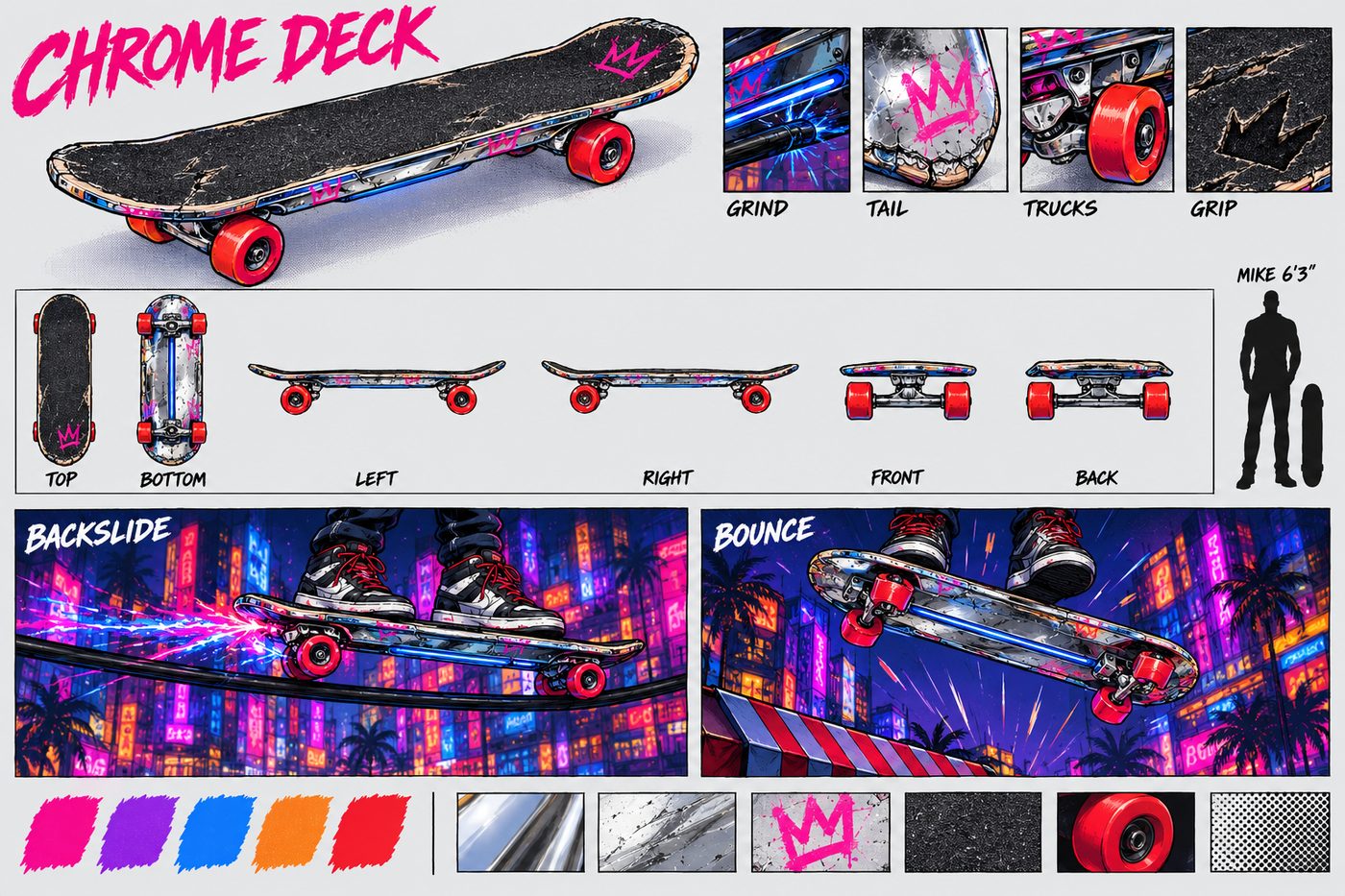
Every wire, awning, billboard and parked car is a rail, a springboard or a wall. Chain the moves, don't repeat yourself, and keep off the ground.
Move 01
Drop low to duck under gaps at speed without losing momentum. In mid-air it works as a fast-fall, and it chains straight into the next rail or bounce.
Move 02
Awnings, cars, dumpsters and umbrellas launch Mike on contact. Time the input to control height and power, and steer off the surface.
Move 03
A sustained run across any wall long enough to hold it, with no stamina timer. Steer round corners and chain into a jump, another wall or a rail.
Move 04
Kick between two facing walls to climb. The Wall-Run takes you across; wall-jumps take you up.
Move 05
Drop flat onto the Chrome Deck and grind any wire or pipe in the city, sparks trailing, switching lines at junctions. Jump off and you get one extra jump in mid-air.
Move 06
A burst of speed while already grinding, to punch along a rail faster.
Move 07
Hold to charge, release to fling Mike a long way up and across. Built for the big gaps.
Move 08
Aim at an anchor (a hook, a sign, a tagged surface, a hooked heavyweight enemy) and zip straight to it in any direction.
Move 09
An instant short dash in any direction with a brief window of invincibility, at a small cost in Flow.
Move 10
The payoff for a full Flow meter: a screen-clearing burst that turns a long chain of movement into one big hit.
Flow fills with every chained move, as long as you stay off the ground and don't repeat the same move twice in a row. Plant your feet and it drains. A full meter arms weapon overcharges and the Wired burst, and both damage and payout scale with the length of your chain.
Style is a live grade of how well you're playing, weighted towards long chains, variety and risk. Fighting in mid-air scores more than the same kill from a rooftop. It's also the money you spend at Socket's workshop. The ranks read like a performance review:
"Mike: Exceeds Expectations. Noted for your file."
Ranged, on the move, and from every direction including behind and above. Aim assist is generous because the skill is in where you go, not how still you hold the crosshair. Every weapon carries its own ammo and needs a real reload. Mike's melee is a finisher: weak on its own, best against anything staggered. Knock an enemy into a toxic slick or an electrified rail and the hazard does the work.
| Status | What it does |
|---|---|
| Slow / sticky | Gums an enemy up in paste and slows it down. |
| Poison | Steady damage over time. |
| Burn | Sets targets alight. |
| Shock / stun | Locks an enemy up for a moment. |
| Marked | Flags a priority target that takes extra damage from everything. |
| Corrode | Eats away armour and defence over time. |
| Amped | The target speeds up but takes heavy damage over time. Risky, but quick. |
| Grossed out | Stack enough and the enemy throws up, staggering it and leaving a puddle that affects anyone nearby. |
| Metabreakdown | When the enemy dies, it bursts and damages everything around it. |
Combos. Statuses stack and combine. Fire meets a poison puddle and detonates. Sticky paste conducts shock to everyone standing in it. A Marked target takes bonus damage from every status that lands on it. Armour blocks statuses until you crack it.
HUD Finishers. Close out a staggered enemy and a piece of the interface reaches into the world to land the last hit. The Flow meter lashes out like a whip, the Style counter stamps down like a falling block, the ammo gauge clubs the target with its own icon. Then it all snaps back as if nothing happened.
Basecamp is The Static's home, a reclaimed rooftop over the rail yard on Tidewater Pier, reached like anywhere else in the city. Node hands out jobs there, new moves come online, and the crew hangs out between runs.
Socket's workshops are hidden all over the city, linked by tunnels underneath it. Weapons, traversal upgrades and wardrobe cost Style. Weapon mods cost scrap, which comes from enemy drops, breaking scenery and Byorn's supply runs. Static favour isn't spent: it builds as you help the crew, liberate survivor hubs and tag Cleanline property, and its milestones unlock gear and side quests.
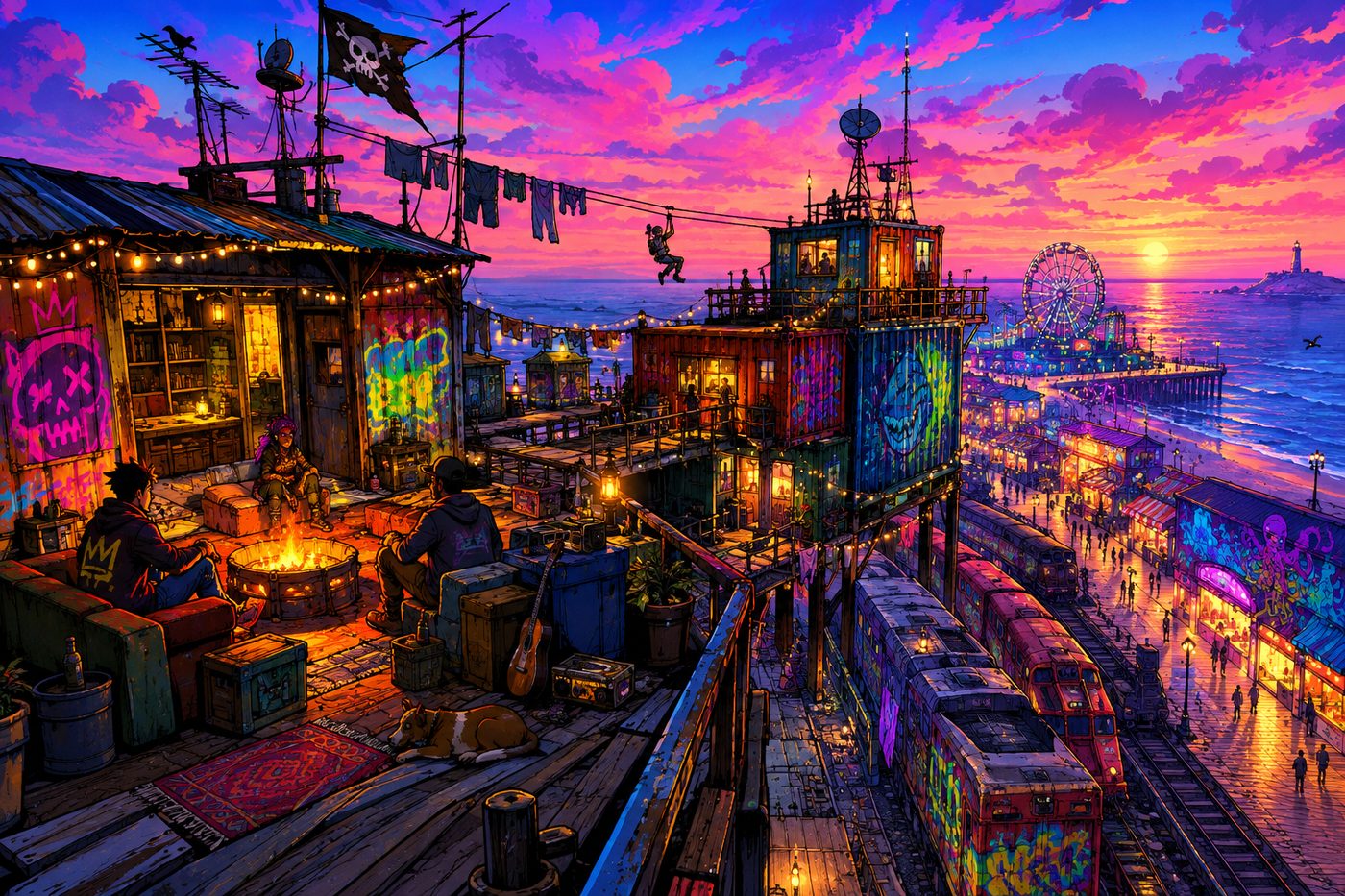
The campaign works through the city one district at a time, from the pier to the Spire, each with its own boss.
Learn the board, meet The Static, take on Cleanline's PR machine.
The dead mall and the marina, and Cleanline bringing in the heavy kit.
Junkyard Dogs country, and The Hound.
The propaganda war in the financial district.
Mike's own neighbourhood, and what Cleanline means by relocation.
The one place no graffiti has ever reached. Yet.
What a real run through Marina Commons should feel like once the systems are tuned:
Mike drops from a skylight mid-Bounce, already carrying two chained moves of Flow. A Scrubber-bot is closing on the wire ahead — the obvious path — so instead of landing on it, Mike Snap-Cuts hard right in open air, dropping flat onto his board to catch a second wire strung behind the mall's atrium, sparks trailing off the underside. Three PR-Drones clock the movement and start buffing each other's plating from above; one fires down early, and the shot skims the board's underside and rips straight back through the drone that sent it — the ricochet paying for itself before the counter-hit even comes up. No single move in that sequence was difficult in isolation; the loop is the point.